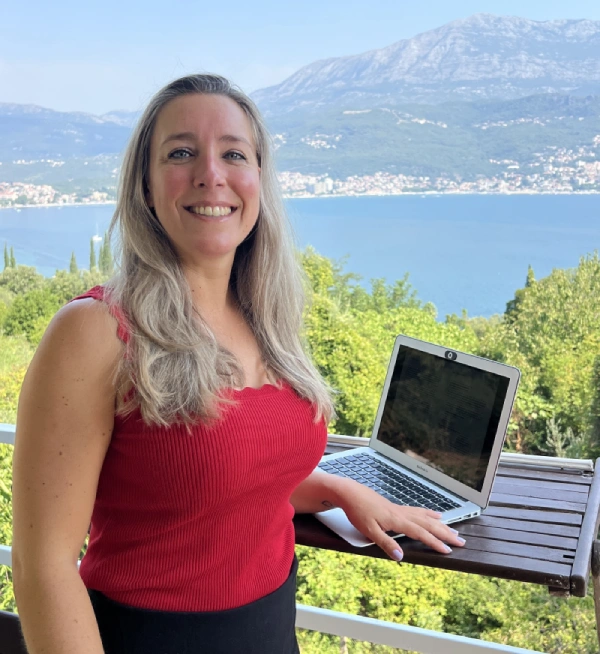


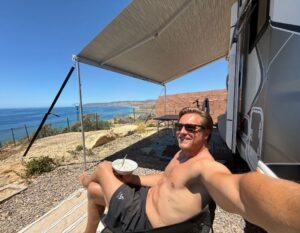
Living in a camper for nine months a year sounds pretty freeing. And it is. But that freedom doesn’t mean I’m on vacation for nine months. I’m Henno van de Hee, a marketer, digital nomad, and vanlifer. I work four days a week, advising B2B organizations on their marketing strategies, presenting plans, and managing various freelancers. My clients expect exactly the same from me as if I were walking into an office in the Netherlands every morning at 8:30 a.m. Whether I’m working from the Netherlands, Spain, or Morocco shouldn’t really make a difference to them.
And that, to me, is the crux of successful remote work: freedom only works if you also take on the responsibility that comes with it.
First, we need to know where we’re going
I work as a freelance marketing consultant and marketing manager, primarily for B2B organizations. When I start working with a new client, I often find that there isn’t yet a solid strategic marketing plan in place. And before we start carrying out all sorts of isolated marketing activities, I want to first understand what our ultimate goal is. That’s why, for me, an assignment usually begins with laying that foundation.
Before I write a plan like this, I want to understand how an organization actually works. I conduct interviews with managers and people on the front lines. I create personas for the organization’s different customer types and then put myself in their shoes to map out their journey: from the first point of contact with the company to becoming—and remaining—a customer.
Once I have a clear picture of how the organization operates, I translate that into a strategic marketing plan. Where do we want to go? Where are the pain points in the customer journey? And what levers can we pull to make that customer journey run more smoothly and efficiently? I then present that plan to the board. And afterward, I’m often asked: “Great plan. Will you also help us implement it?”
From Consultant to Marketing Manager
When that request comes up, I stay on as a freelance marketing manager and take on a large portion of the marketing responsibilities. That said, I certainly don’t do everything myself, because the marketing field has become so specialized that I don’t delude myself into thinking I can be the best at everything. That’s why I work with a network of freelancers—from graphic designers and web developers to photographers and event managers—all of whom I work with remotely. I mainly take on projects that align with my strengths and interests, and for specialized work, I hire people who are simply better at it than I am.
As a result, my role has become increasingly strategic, advisory, and coordinating. I like to take a step back from the day-to-day details; I want to have enough substantive knowledge to make sound decisions and then direct the right people to carry them out. That also makes my work well-suited for working remotely as a digital nomad.
My travel year actually begins in the Netherlands
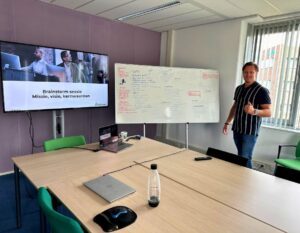
My work style now largely determines my travel schedule. I spend most of Q3 and Q4 in the Netherlands, because for many organizations, that’s the period when plans for the following year are drafted, discussed, and finalized. Priorities must be clear and the marketing budget must be set by the end of the year, and that’s exactly the kind of work for which I prefer to be physically present at an organization.
I want to talk to people, conduct interviews with managers and staff, get a feel for the atmosphere within an organization, and understand how processes actually work in practice—rather than just how they’re described on paper. Next, I want to sit down with management to make decisions. Once that foundation is in place, my role changes: implementation begins in January, and I can easily carry out or coordinate a large part of that from abroad. As a result, my ideal work year has actually turned out to be surprisingly logical.
The freedom to work remotely requires, above all, discipline
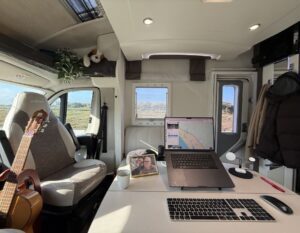
Just because I happen to be in Spain or Morocco doesn’t mean my work is any less serious. People often ask me what the biggest challenge is about working from a camper, and my answer is, without a doubt: discipline. You’re in the most beautiful places, the sun is shining outside, and the people around you are often on vacation. Someone asks if you want to go surfing, someone else wants to grab lunch somewhere, and yet another person pops open a bottle of wine at 3:00 p.m. And you have to open your laptop. That might sound simple, but it’s probably the most important requirement for sustaining this lifestyle over the long term. If I have a meeting scheduled with a client, I can’t just say: “Sorry, but the waves were really good today.”
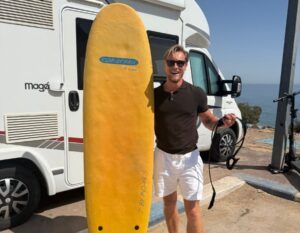
I work four days a week and also manage other freelancers and business partners. Ultimately, I’m responsible for what we deliver together, and whether my RV is parked on the Dutch coast or somewhere in southern Spain doesn’t change that.
And then your internet goes down
In addition to discipline, there’s, of course, the practical reality of an office on wheels. A reliable internet connection is essential: a large part of my work involves video calls, sharing documents, collaborating online, and coordinating projects, so I don’t want to be dependent on the hit-or-miss Wi-Fi at a campground. That’s why I use Starlink, among other things—internet via a satellite connection—which makes me much less dependent on local Wi-Fi or a good 4G or 5G connection. It works great—until you try to cross the border into Morocco, have some bad luck, and your Starlink is confiscated by customs. Those kinds of things are just part of the deal: you can plan an awful lot in advance, but something always happens along the way that you didn’t anticipate.
How much electricity, water, and toilet paper do I have left?
And the internet is really just one part of it. When I’m camping in the wild, my RV has to be completely self-sufficient. My solar panels charge my household batteries, but if the sun barely makes an appearance for a few days, the charging slows down considerably. Meanwhile, my laptop, phone, and other devices still need to keep running as usual. The same goes for water. How much is left in the tank? Where can I refill it? How long can I shower before I end up cursing myself later for running out of water? And then there’s one of the big questions every camper faces:
How much longer will my toilet cassette last?
These aren’t exactly the kinds of topics you see on Instagram when someone posts a photo of their laptop with a view of the sea, but they definitely determine how comfortable you can be working in a given place. That’s why, during hectic work periods, I often end up at campgrounds. There, I have electricity, water, and amenities within easy reach, so I don’t have to constantly worry about them. Wild camping with a view of the sea is fantastic, but if you have three important meetings in one day, a campground with reliable amenities is sometimes a lot more relaxing.
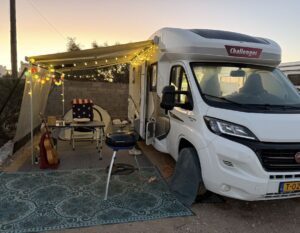
A travel day isn’t automatically a day off
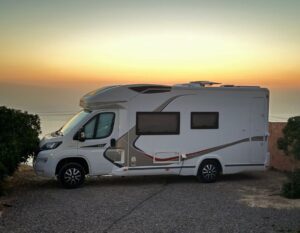
My schedule also requires a bit more planning than when I work from the same office every day. For example, on a travel day, I try to keep my schedule as free of meetings as possible, but that doesn’t always work out: sometimes I have to open my laptop in between other tasks. Then suddenly you find yourself in a parking lot along the highway in Spain, attending a Teams meeting. That, too, is remote work. That’s why I’m trying to anticipate and mitigate more risks in advance: making sure I have enough power, having multiple internet options, organizing my schedule wisely, and not waiting until five minutes before an important meeting to find out if my connection is good enough. I’ve almost turned it into a sport by now.
The view isn’t the most important thing
Maybe that’s actually the biggest misconception about remote work: in the end, it’s not at all about that laptop with a view of the ocean. Of course, it’s fantastic when I open the door of my camper in the morning and find myself somewhere on the coast, or when I can grab my surfboard after work. But that’s just the bonus. The bottom line is that my clients have to be able to trust that I’m doing my job well, because if I don’t, this lifestyle will naturally come to an end. For me, freedom doesn’t lie in having less responsibility, but rather in the ability to decide for myself where I take on that responsibility.
That’s why I’m in the Netherlands now
And that brings me straight to my current situation. My RV is in the Netherlands for the time being, and over the next few months, my focus will once again be more firmly on work, because this is the time of year when I like to sit down with organizations to lay out plans for next year. My schedule for Q3 and Q4 also still has room for a new client. So I also want to network and get my name out there. Do you know anyone looking for a marketer? Ideally, I’d like to have that sorted out before the end of the year, because on January 1, I’d naturally like to get back to my van life as a digital nomad. 😉 Want to get to know me? You can find me on LinkedIn at or on Instagram @hennovandehee.
This is Part 2 of Henno’s story. In Part 1, you’ll read about how a burnout made him rethink the role of travel in his life, why he spent his savings on a camper van, and how a “workation” ultimately became the start of a completely different way of life.
More inspiration on working remotely from a camper
Digital nomad Alieke’s ervaring met vanlife: de ultieme vrijheid op wielen
Leven en werken als digital nomad – met een camper, kat en laptop
Van burn-out naar 9 maanden per jaar wonen en werken in mijn camper