

Kenya had been on my list for some time, but honestly, I wasn’t quite sure what to expect as a digital nomad. Is the wifi stable enough? Can you work there comfortably? And what about safety and practical matters? Meanwhile I can say: Kenya has positively surprised me, but it is not a destination you go to blindly without preparation.
In this blog, I share my experience working remotely in Kenya, including the places I stayed, what worked well (and what didn’t), and practical tips that will really help you. I also went on safari, of course, an unforgettable and impressive experience and must see if you go to Africa.
Benefits of working remotely in Kenya
Let me start with why Kenya is interesting at all as a digital nomad destination. The temperature is a big plus, being around 32 degrees on the coast and 25 inland. I traveled in February and March, which officially heads toward the rainy season. In practice, this was not so bad: it rained mostly at night and during the day I often had sunshine and pleasant temperatures. In addition, the time difference is ideal. For Europeans it is only 1 or 2 hours later, depending on the period. That means that you can plan meetings without difficulty and just keep working in the same rhythm. Also practical: there are direct flights from Amsterdam. Then it’s a 9-hour flight.
Practicalities in Kenya: this is what you need to arrange
Kenya is not a country you “just go to” without preparation. A few things you simply must have well arranged in advance. Vaccinations are required, so check this well in advance. You also need to apply for a visa (eTA), which fortunately you can easily do online and in my case was arranged within 2 days. Since 2025, Kenya also has an official digital nomad visa. That makes it a lot more interesting if you want to stay longer.
Paying is surprisingly easy via M-Pesa, a mobile payment system used really everywhere in Kenya. Ideal because you hardly need to carry any cash in your pocket. One important tip though: you have to identify yourself with your passport when you top up, so only do this at trustworthy stores to avoid hassles with identity fraud.
In terms of Internet: buy a local SIM card from Safaricom or use an eSIM. Wifi, in fact, is not equally stable everywhere. In some places it worked perfectly, at other times it was disappointing. So doing good research on your accommodation in advance is not a luxury.
And yes, power outages do happen. In 3 weeks, I experienced it about 5 times. Sounds a lot, but in practice it wasn’t too bad because most accommodations have a generator that comes on immediately. So you often don’t notice it much. I did always make sure that my laptop and phone were charged when everything was working, just in case.
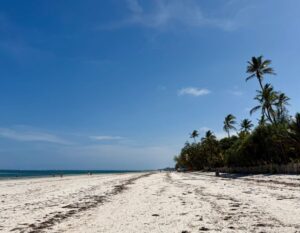
Diani Beach: working with your feet in the sand
My trip in Kenya began on the coast, near Mombasa, in Diani Beach. That was because I flew through from my workation in Zanzibar (also highly recommended by the way!). In my opinion, Diani Beach is the place to be if you want to combine work with a relaxing beach environment. Life here goes ‘pole pole,’ nice and slow. Diani Beach feels quiet, green and friendly without mass tourism. You have long white beaches, palm trees and a relaxed atmosphere here. Except that you are accosted every 5 meters if you want to buy something, which I did find slightly irritating. It is not a party destination, but rather a place where you get into a quiet rhythm.
I stayed at Diani Pearl Hotel, which was a nice base. Just off the busy street, nice and quiet and great sweet staff. Very good rooms, no bugs in the apartment (very nice), a nice pool and oasis of calm. A great place to combine work and relaxation.
Remote working in Diani Beach
I expected to encounter more digital nomads, but they could be counted on 1 hand unfortunately. I suspect many people here choose a resort for their stay, and then work there as well. What works well here is that many beach resorts offer day passes, where for €10 you buy a credit for which you can order food and drinks. You can then use their facilities and often just work in the restaurant.
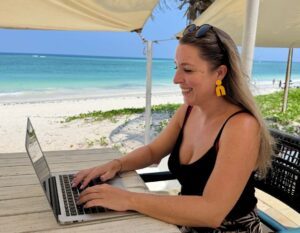
Tips for great spots in Diani Beach
- Kokkos Cafe: a great place to have breakfast, lunch, dinner or work. I was a regular here haha. There is no air conditioning, but there are fans, so you have to be able to stand a little heat.
- Funky Monkey Diani Beach: a good atmosphere and very good food. It is also very affordable. Think about about €10 for a main course.
- I also worked one day at Diani Reef Beach Resort & Spa, but I honestly did not recommend it. Way too high a price for admission, little atmosphere and when I plopped down on my beach bed after working, the staff came by 5 (!) times to sell their activities, not okay!
Nairobi: busy, lively and not for everyone
Then I traveled on to Nairobi. This is a completely different experience. Six million people live here. Nairobi is crowded. And noisy. Day and night you can hear music and traffic everywhere. They rather like to party with loud music here and think everyone wants to enjoy it, which cost me my sleep several times. So don’t forget your earplugs, and noise-cancelling headphones if you want to work focused.
In addition, I did not find it a city to walk through in a relaxed manner. As a tourist, you are constantly being accosted, which can be annoying and tiring at times. My advice: get around with Uber or Bolt. For about €3 you already have a 30-minute ride. That makes it easy and safe to get around.
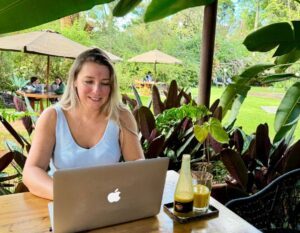
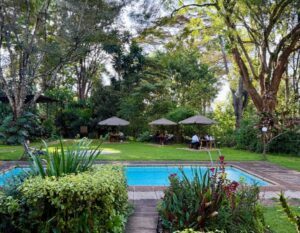
Remote working in capital Nairobi
Nairobi is a city where many countries in Africa gather for business. This is partly why there are an awful lot of coworking spaces, which is nice for digital nomads looking for a good place to work. These are my favorites:
- Ikigai Nairobi – there are 5 locations in the city, of which Ikigai Westland is my favorite. A green oasis, very nice vibe and founded by 2 sisters, who run a completely sustainable location.
- Connect Coffee Roasters – a place with good coffee, which they grind on site, and very tasty snacks. The croissant with chocolate topping comes highly recommended. It’s a great place to work, with lots of remote workers.
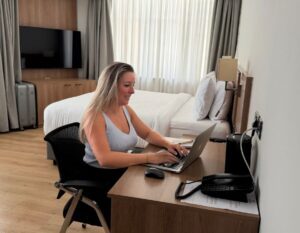
- In terms of accommodation I was at Urbanwoods Hotel Suites, in the up-and-coming neighborhood of Kilimani. There is very good internet, a desk in your room and an insane workspace on the 16th floor overlooking the Nairobi skyline. There is also a bakery and restaurant, so cooking for yourself was not necessary, not a punishment I can tell you.

What to do in Nairobi?
While you’re there, it’s fun to explore the city a bit and these are recommended:
- Nairobi National Museum: to learn more about the history and culture of Kenya. A museum with lots of information about the country’s nature, animals and impressive history.
- A walking tour: a local will tell you super many interesting facts about Kenya. I often choose Guru Walk, they have a lot on offer and good guides. I usually tip €10-15, it’s more than worth it.
- The River Cafe is a fine place for rest and nature away from the hustle and bustle of the city.


Masai Mara: working in the middle of nature
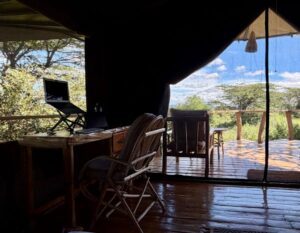
An absolute highlight of my trip was Masai Mara National Reserve. Of course mostly for the safari and wildlife, but also because I was here at the most impressive workspace ever. And I’ve seen quite a few haha.
Of course did a game drive safari here and saw the Big Five, lucky me! That is one of those moments where you forget for a moment that you are normally sitting behind your laptop. Truly bizarre to experience this in real life. I stayed at Mara Hilltop, in a luxury safari tent. What made this extra special: they had Starlink Internet here. So yes, you can just work here with high-speed internet in the middle of nature. At night, you might just run into a zebra near your tent, and you can often hear the hyenas nearby. But no worries, it’s just outside the National Reserve, so perfectly safe. And the Masai keep a close eye on everything.

The bucket list train journey: from Mombasa to Nairobi
A highlight I was also greatly looking forward to was the train ride on the Madaraka Express from Mombasa to Nairobi. A ride of about 6 hours. This train goes right through Tsavo National Park, so you just see wildlife along the way. I saw zebras, antelopes, monkeys and even two elephants. I really liked the experience.
Practical Tips for Madaraka Express:
- Take the 8 a.m. train, which is when you have the best chance of seeing wildlife.
- Be at the station at least an hour in advance (you have to go through 3 security checks)
- Buy your ticket in advance online (if you use M-Pesa it’s €10 for 2nd class)
- The train is comfortable, with air conditioning, clean toilets and food on board
A remote work adventure in Kenya
Kenya is not an “easy” or obvious digital nomad destination like Bali or Portugal. You have to prepare things better, be more flexible and sometimes accept that not everything works perfectly. Welcome to Africa. But that’s exactly what makes it interesting. They don’t do a rat race here, and if things don’t work out today they will tomorrow.
You combine working here with experiences you have in few other places: safaris, beaches, a totally different culture and nature that you cannot compare to Europe. My advice? Don’t go without a plan, but do go! If you get it right, Kenya is a destination that will stay with you, not only as a traveler, but also as a digital nomad.
Tips for other adventurous digital nomad destinations
Remote werken in Marokko: de ultieme gids voor digital nomads