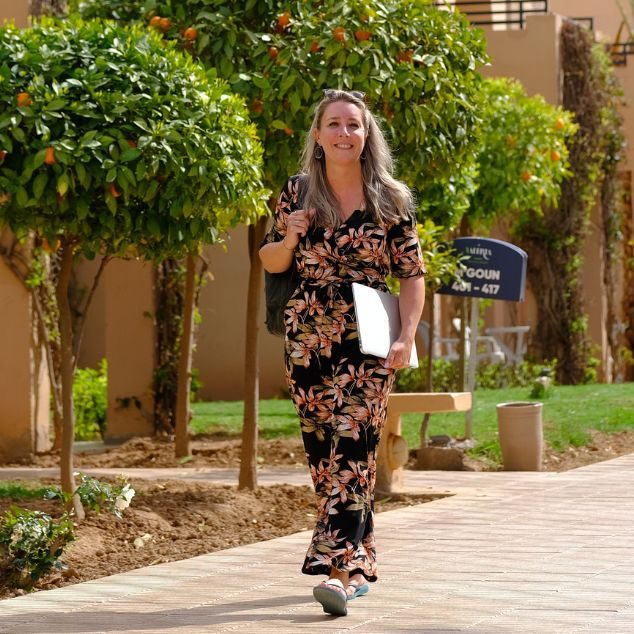


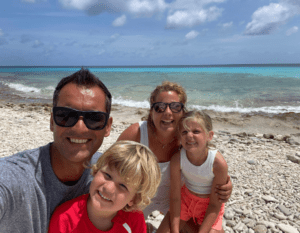
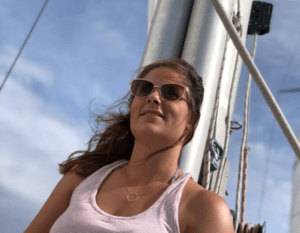
With remote working, many people think of freedom and working from beautiful places. I recognize that image, but it doesn’t tell the whole story. For me, remote working is also a practical solution: a way to organize work and life so that they reinforce each other and leave room for the life I want to lead. I am Marjolein Boom, communications consultant, partner of André Peter and mother of Noor (8) and Finn (5). The four of us live on a catamaran. Not as a long vacation or world trip with an end date, but as our daily life.
A life without a permanent address
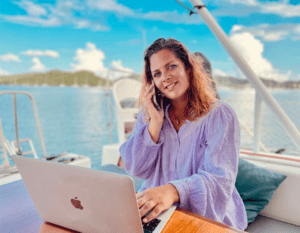
For 2.5 years I have been working from a catamaran in the Caribbean. In those years it has become increasingly clear to me that working well has hardly anything to do with where you are, but everything to do with how you organize your work, how you communicate and how you are present, even if it is at a distance.
Before we left we lived in Apeldoorn, in a nice house in a pleasant neighborhood. We had a good life and everything was comfortably furnished. Yet slowly the realization grew that we wanted to shape our lives differently. Not wait until later, not postpone until the children were older, but make time and space together now for a life that suited us better.
We sold our house and almost all our belongings and left for Martinique with seven suitcases. That’s where our life at sea began. Since then, we have seen a lot. We sailed from Martinique to the ABC Islands, Colombia and Panama, anchored off the Cayman Islands, explored Cuba, the Dominican Republic and Turks & Caicos, and moved on to Puerto Rico and the islands of the eastern Caribbean.
The children are taught on board and sometimes attend a local school on an island.
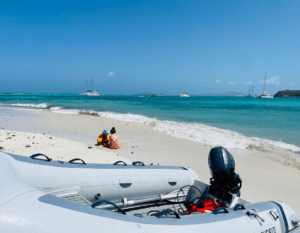
Yet this life rarely feels like travel in the classic sense. We sail about 20 percent of the time and lie at anchor the rest, sometimes in the same place for weeks at a time. As a result, countries don’t become stopovers, but a temporary home where daily life takes place as usual. The children are taught on board and sometimes attend a local school on an island, I work, we run errands and become familiar with how things are arranged locally. If we like it less somewhere or the weather changes, we pull anchor and sail on.

Communication as a common thread in my work
My work I took with me. I have been working as a communications consultant for years and began my career in the theater world, where communication is all about perception, timing and sensing the audience. From there I made the switch to the healthcare sector, where communication is often more complex and therefore so important. I now also work for profit organizations, which provides variety and new perspectives.
What ties all these assignments together is the core of my work: helping organizations communicate clearly and understandably, without becoming unitary. I don’t believe in standard solutions. For me, good communication starts with listening, with really understanding who an organization is, who the recipient is and what dialogue needs to be conducted. Only then do I look at what strategy, tone and means are appropriate.
Shaping remote working
Remote working was not a pre-determined career path for me, but a logical consequence of the choices we made. With a desire to make this life possible even while working, I started a conversation with my then-employer. I asked if there was an assignment I could continue to do remotely. That open conversation was the beginning of everything that followed.
I started my company in Estonia and from that first assignment I started to approach my network. The ball started rolling. Most of my work still arises through word of mouth, through people who know how I work, no matter where I am.


Early working days and clear communication
My workdays start early. I start work at six in the morning so that I can plan my appointments with Dutch organizations. I work until lunch and notice that when the working day ends in the Netherlands, there is also peace and quiet here. I chose this structure consciously. It helps me to work in a focused way while keeping space for life around me.
Remote working requires clear agreements and making expectations explicit. Precisely because you do not naturally meet at the coffee machine, clear communication is important. This applies to accessibility, to deadlines, but also to trust and mutual understanding.
Expectations and trust, not always expressed
In conversations about my work, I sometimes notice that expectations come into play. Not always expressed, but palpable. By this I do not mean doubts about my work, but the image that many people have of what work looks like: a fixed place, fixed times and physical presence. The questions that arise from this are then less about the content of the work and more about the form: what does such a working day look like, how accessible are you, how does collaboration work if you don’t see each other physically? These are understandable questions.
In practice, I find that they quickly disappear once the collaboration begins. Being consistent, keeping appointments and communicating transparently creates trust. I notice that this bond is sometimes even stronger than with colleagues I used to only meet at the coffee machine. Perhaps because distance creates space: people are more likely to share what is on their minds, and trust therefore grows faster than you might expect.
Life at sea as a teacher
Life on a boat is not a romantic setting, but a constant exercise in flexibility. Things break down, plans change and solutions are not always readily available. Parts are sometimes simply unobtainable, which requires creative thinking and a lot of patience.
I like overview and control, and that is precisely why this life is sometimes confronting and at the same time instructive. Not everything can be made or planned, but that doesn’t mean things go wrong. I take that attitude into my work as well. Less quick to stress, more often looking at what is possible and trusting the process.
The learning process of remote working
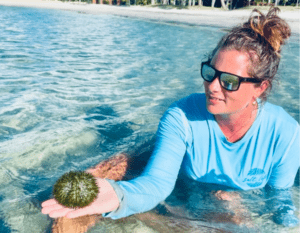
Because of this life, I look at time, property and success differently. In many Caribbean countries I see how people, even after major events such as a hurricane, rebuild their lives with tremendous resilience. That puts things into perspective and brings me back to the essence. I enjoy small things more: a beautiful flower, a butterfly, swimming with a turtle and the wonder of our children. It has enriched my view of other cultures, but also changed my view of myself. I have become more flexible and better able to deal with uncertainties, although that remains a learning process.
Looking ahead without a fixed plan
Because we have seen so much in the Caribbean, I find that other parts of the world are attracting me more and more. Nature and other cultures make me intensely happy. Asia, Australia and South Africa are high on our list.
This is not a journey with an end point. It is a way of life that has taught us much about letting go and trusting, about moving along and making choices, and about working in a way that fits the life you want to live.
Contemplating life at sea
If you dream of remote work or a different life, I would say: don’t wait until everything is perfect. That moment won’t come. Start small, look into your network, build confidence. Sometimes the first steps may not be exactly what you envisioned, but they will bring you closer. And take your time. When you are somewhere, actually live there. Become absorbed in everyday life, no matter how uncomfortable it sometimes feels!
Want to follow us on our adventures? Instagram: @buroopzee & @sailingindigofamily. Website: www.buroopzee.nl
More inspiration on remote working and experiences of others
Van Lapland tot Japan: wereldwijd werken als gids en digital nomad
Digital nomad Alieke’s ervaring met vanlife: de ultieme vrijheid op wielen